Paseo Baquedano
The wooden pedestrian promenade that starts beside the square and is the best starting point for the walk.
How to get to Paseo Baquedano →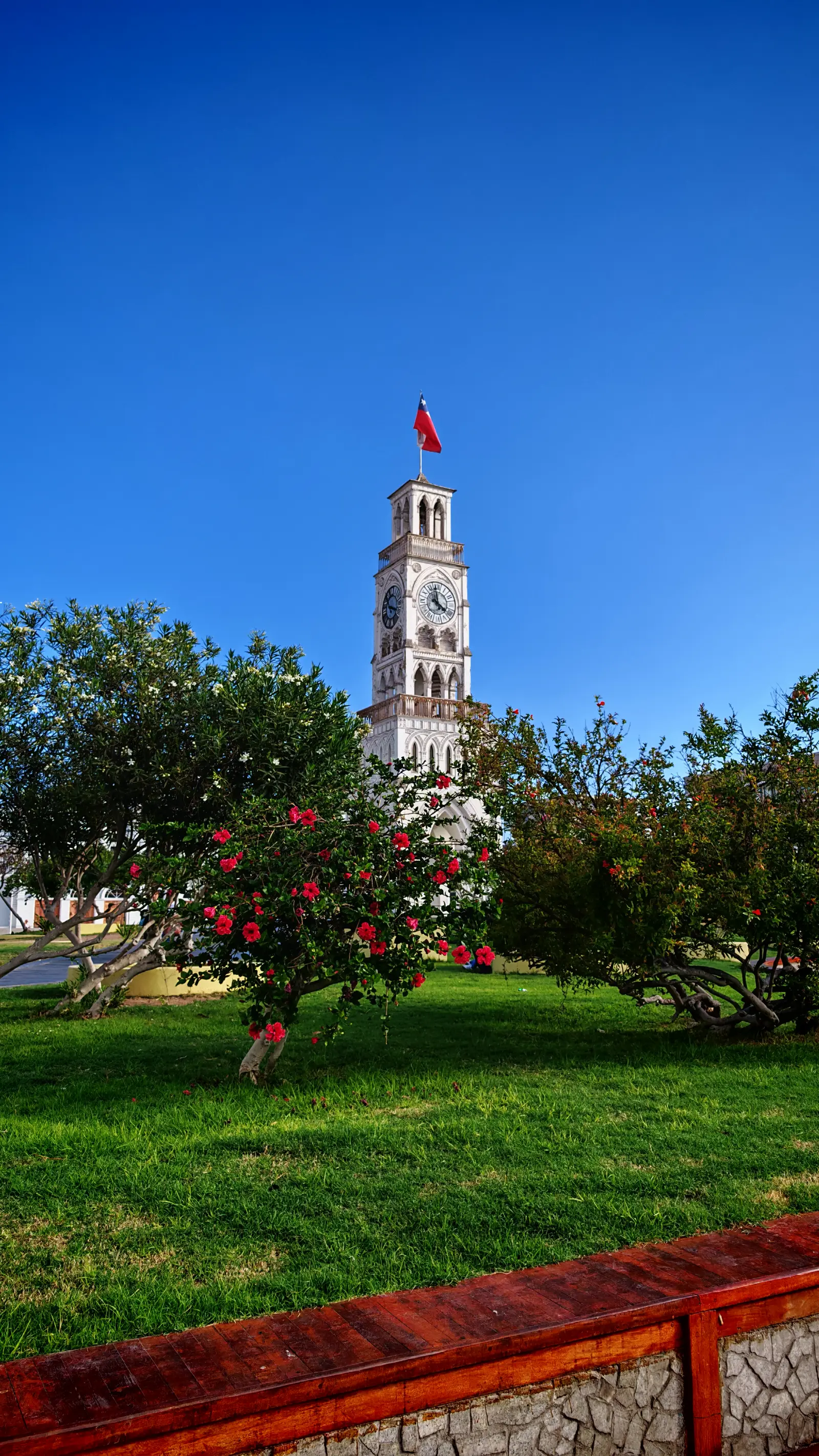
An 1877 urban landmark at the heart of Plaza Arturo Prat: the Clock Tower, a wooden symbol of Iquique's nitrate-boom glory.
🕒 Open 24 hours
Welcome to Torre del Reloj, widely recognized as the central Iquique Clock Tower. Located in the heart of Iquique, Tarapacá, Chile, this destination serves as a primary hub for travelers visiting the region.
Torre del Reloj is Iquique's most recognisable wooden landmark and the symbolic centre of Plaza Arturo Prat. Built in 1877 with Oregon pine shipped in by sea, its clock still sets the rhythm of the historic centre between the Atacama desert and the old nitrate port.
Torre del Reloj stands in Plaza Arturo Prat, on Baquedano street, in the historic centre of Iquique, Tarapacá. It is reached on foot from the Baquedano Promenade and the seafront; the square is flat, accessible and open 24 hours with free entry.
Around Torre del Reloj visitors find the Baquedano Promenade, the Iquique Municipal Theatre and the Oregon-pine mansions of the nitrate era. A few minutes away are Playa Cavancha and the Free Zone (Zofri).
Raised in 1877 during the nitrate boom, Torre del Reloj commemorates the era when Iquique was one of the world's leading nitrate-export ports. Its Moorish style and Oregon-pine structure made it the heritage symbol of the city.
When visiting Torre del Reloj, visitors can easily explore surrounding historical landmarks and points of interest, including Paseo Baquedano and Teatro Municipal de Iquique.
Check current conditions and the outlook to decide whether you need an umbrella, a hat or a light layer during your visit.
Weather warnings
What to wear
How to plan your visit
What to pack
Updated: 02:57 AM
Weather source: Open-Meteo
The Iquique Clock Tower is one of the city's most recognisable images. Raised in 1877 at the height of the nitrate boom, when Iquique was among the richest saltpetre ports in the world, the tower stands in Plaza Arturo Prat, facing the Baquedano pedestrian promenade. It is not built of stone or brick: it was made with Oregon pine shipped in from the north, a precious timber on the desert coast. With its Moorish style and a clock that still keeps the hours, it is a living witness to the golden age of saltpetre and a must for anyone walking the historic centre of Iquique.
The Clock Tower is a heritage landmark of Iquique's historic centre, tied to the nitrate boom of the 19th century. Built in 1877 with Oregon pine brought by sea, it is part of the historic ensemble surrounding Plaza Arturo Prat. Today it is a publicly accessible space of free entry, maintained within the framework of the city's identity and memory, together with the Municipality of Iquique and the regional agencies of Tarapacá.
The Clock Tower stands at the centre of Plaza Arturo Prat: this is the walk that connects it with the rest of Iquique's historic centre.
The tower does not stand alone. It rises in the middle of Plaza Arturo Prat, where the Baquedano pedestrian street meets Iquique's historic centre. Around it are the Municipal Theatre, the Oregon pine mansions of the nitrate era and the seafront that runs down to Cavancha Beach, so the visit is best completed on foot.
Address
Baquedano Street, Plaza Arturo Prat, Iquique, Tarapacá Region, ChileThe wooden pedestrian promenade that starts beside the square and is the best starting point for the walk.
How to get to Paseo Baquedano →One of the most elegant heritage buildings in the centre, less than a block from the tower.
See the map and exact location →The nitrate-era houses explain the tower's own material and its historical context.
History and architecture of the Clock Tower →Iquique's best-known city beach, about 15 minutes on foot along the seafront.
Today's weather in Iquique →Before the walk it is worth seeing how the light on the tower changes through the day.
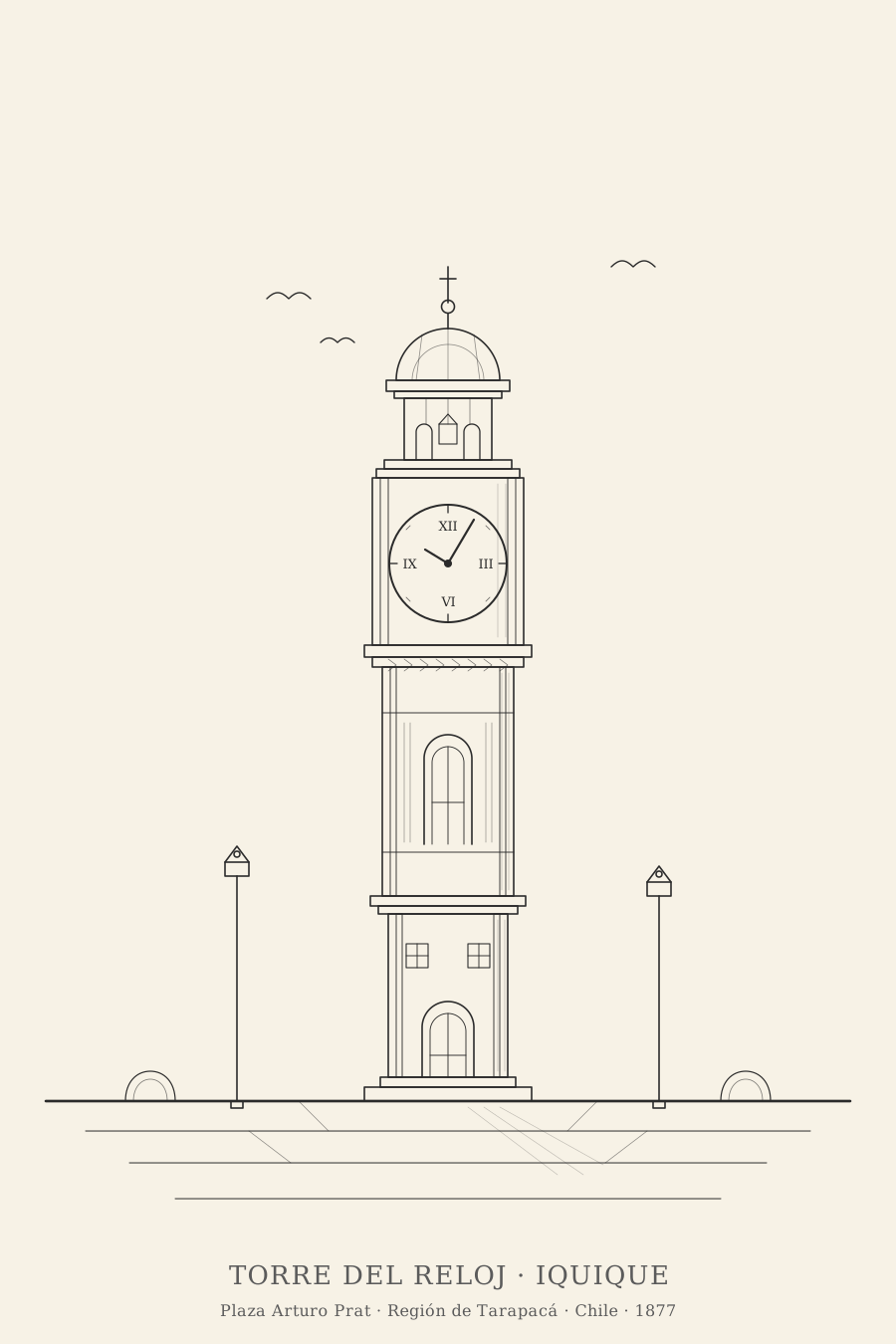
Photos of the Clock Tower and the square →The line illustration helps you recognise the silhouette and the domed top.
Drawing of the Clock Tower →Iquique has no train or rail service; the real decision is how to reach the city and then move around the centre on foot, by taxi or by city bus.
Apart from the overland border crossing, Iquique is reached by plane or long-distance bus. Diego Aracena Airport (IQQ) is about 45 km south of the centre; the Iquique Bus Terminal is in the city. Once here, the tower is in the flat, compact centre, so on foot, by colectivo, taxi or city bus you arrive in just a few minutes.
Arrival by plane
For those coming from far away, flying is the most comfortable way to reach Iquique.
Long-distance bus
The bus is the budget option to reach Iquique from the rest of Chile.
Within the city
For the last stretch, Iquique's urban transport is fast and cheap.
Walking or cycling
Central Iquique is flat and compact, ideal to explore on foot or by bike.
Practical information on the types of service you will find around the Clock Tower: restrooms, parking, food, accommodation, shopping, fuel and EV charging, among others.
⚖️ Neutral directory: we only describe the types of service available in the area. We do not promote, recommend or list any specific business.
The square has no restrooms of its own. In the city centre there are public toilets and hospitality venues offer facilities to their customers. Carrying tissue or hand gel is a good idea.
📍 City centre, a few metres
On-street parking with meters and paid car parks in the historic centre. Demand is high in summer and at weekends; arriving early or walking in is usually quicker.
📍 Streets around the square
A varied offer of local, seafood and fast-food options, plus cafés, bakeries and ice-cream shops. Choices exist for different budgets and diets.
📍 Pedestrian promenade and nearby streets
Accommodation in several categories: hotels, guesthouses, residential hostels and tourist apartments. There is also supply along the seafront and near Cavancha Beach.
📍 City centre and seafront
Supermarkets, convenience stores, pharmacies and neighbourhood shops for essentials. The duty-free commercial zone is a few minutes away by vehicle.
📍 Central streets
Petrol stations with liquid fuel and electric-vehicle charging points across the city. It is wise to check availability and connector type on arrival.
📍 City outskirts, by vehicle
ATMs and bank branches in the city centre, with reduced hours at weekends. Carrying some cash is useful for small shops.
📍 City centre
Primary-care centres, private clinics and pharmacies, with on-call emergency rotas. In an emergency, contact the country's public emergency services.
📍 Centre and surroundings
Tap water is drinkable. Public fountains and shaded areas are limited, so carrying a refillable bottle and protecting yourself from the sun is recommended.
📍 In and around the square
Mobile coverage across the city and wifi in hospitality venues. Outdoor signal and reception inside older buildings can be irregular.
📍 Throughout the area
The square is flat and paved, navigable with wheelchairs and strollers, with adapted crossings on the surrounding streets. The wooden promenade may have slight gaps between boards.
📍 Square and pedestrian promenade
Urban bus stops, taxis and ride-hailing services on the nearby avenues. The historic centre is compact and best explored on foot.
📍 Nearby avenues
Distances are indicative and measured on foot from Plaza Arturo Prat. Availability and opening hours may vary by season.
1877
The Clock Tower is raised in Plaza Prat at the height of the nitrate boom, using Oregon pine brought in by sea.
1880-1900
Iquique's golden age as one of the world's leading nitrate-export ports; the square consolidates as the civic centre.
20th century
With the nitrate crisis and the arrival of synthetic nitrates the city changes pace; the tower remains the reference point of the historic centre.
Today
The tower is Iquique's heritage symbol, a civic meeting point and an essential stop on the historic walk beside the Baquedano Promenade.
The Clock Tower was erected in 1877, at the highest point of what was then Plaza Prat, during the nitrate fever, when Iquique was the main nitrate-export port of Chile and one of the wealthiest cities of the South Pacific. In the desert, timber was scarce; that is why Oregon pine was imported on the ships that left loaded with saltpetre. The tower was conceived as a public clock and ornament of the civic promenade, and its Moorish style reflected the exotic, elegant taste of the nitrate elite.
It was placed in the centre of Plaza Arturo Prat because the historic centre was the social and commercial heart of Iquique. From the tower, people set their day by the public clock and the plaza became the stage of city life: strolls, meetings and celebrations. Symbolically, the wooden tower is the perfect contrast between the Atacama desert and the cosmopolitan ambition of the saltpetre port.
Those who grew up in Iquique say that, on windy desert nights, the tower's pendulum seems to keep a different beat, as if the time of the saltpetre still pulsed in the wood. Another popular story says nitrate families used to meet under the tower on the hour, and that whoever kissed beside it at noon would always return to Iquique. Legend or custom, the tower remains the city's meeting point.
Today the Clock Tower is one of the symbols of Iquique and the backdrop of Plaza Arturo Prat. Alongside the Baquedano Promenade, the Municipal Theatre and the Oregon-pine mansions of the nitrate era, it forms part of the heritage route of the centre. It is also the gateway to understanding the urban history of Tarapacá and the legacy of the nitrate boom in northern Chile.
The tower is a piece of timber engineering: an Oregon-pine body, assembled and painted, crowned by a small lantern and dome, with the clock face as its focal point. Building in timber was no eccentricity in a desert city — Oregon pine arrived by ship and offered long, light, resistant pieces that were easy to transport and work. Its Moorish-inspired ornament — arches, mouldings and finials — was the aesthetic signature of the nitrate elite, who imported European and exotic fashions to set their buildings apart. Notice how the white tower stands out against the sky and the neighbouring façades: it is a piece of urban scenery in itself.
In 1877 Iquique was far more than a port: it was one of the wealthiest cities on the South Pacific, thanks to nitrate. Saltpetre was mined inland and shipped from here, and that trade attracted merchants, technicians and immigrant families from Europe, Asia and the rest of the Americas. The city grew in timber, with promenades, theatres and social clubs. The main square concentrated that pride: banks, shops, public buildings and, at its centre, the tower that kept time for everyone. Understanding that context is understanding why a wooden tower from 1877 is still the symbol of the city.
Beyond the legends about the pendulum and the bells, oral stories about the square are still passed on in Iquique: that sweethearts met at the foot of the tower, that street vendors set the rhythm of their day by its chimes, and that newly arrived sailors used it as a landmark to find their way. These are accounts of popular memory rather than historical documents — which is exactly why they show how the community turned the tower into an emotional reference point.
Some details are easy to miss: the clock face and hands, the upper finial and its dome, the white painted joinery renewed with each maintenance cycle, and the contrast between the lightness of the timber and the solidity of the neighbouring buildings. At sunset the tower changes character; at night, lit up, it becomes the most photographed spot on the square. Look also at the wooden decking and street furniture of the Baquedano Promenade — they belong to the same heritage ensemble.
The tower is part of the heritage ensemble of Iquique's historic centre, alongside the Baquedano Promenade, the Municipal Theatre and the Oregon-pine mansions. As a timber structure exposed to sun, coastal humidity and desert wind, it requires periodic maintenance and repainting. Visiting is also a way of caring for it: not climbing on or forcing elements, respecting the furniture and keeping the square clean helps this symbol stand for generations to come.
Two short visitor quotes break up the long read and reinforce the plaza's mix of history and experience.
“A small landmark but full of history. Right on the plaza, ideal for a quick photo and to learn about nitrate-era Iquique.”
“Beautiful at night with the lighting. The Baquedano Promenade next to it is the best for walking without a car.”
Source: user reviews published on Google Maps.
📍 See the full reviews on Google MapsPractical Planning
As a public square open 24 hours, the Clock Tower can be visited at any time; the best light and fewest crowds are usually early in the morning.
Explore the Clock Tower and Plaza Arturo Prat through concrete scenes, from the Oregon pine to the Moorish charm.


A line illustration of the tower so you can recognise its silhouette before you visit.

This drawing sums up the anatomy of the Iquique Clock Tower: the Oregon pine body, the clock face that has marked the hours since 1877, and the domed top with its cross. It is a line illustration, useful for recognising the tower from anywhere in Plaza Arturo Prat or along the seafront.
Original illustration created for this guide.
Visitor feedback is available on Google Maps (external link).
A small landmark but full of history. Right on the plaza, ideal for a quick photo and to learn about nitrate-era Iquique. Free entry and always open.
Beautiful at night with the warm lighting. The Baquedano Promenade next to it is the best for walking without a car and feeling the historic centre.
A great starting point to walk the centre. Bring water and a hat: there is no shade in the plaza and the sun is strong.
The wooden tower is curious; you can tell it is from another era. Combined with the Municipal Theatre it makes a very complete heritage walk.
Plaza Arturo Prat, Baquedano street, Iquique, Tarapacá Region, Chile
Chile / Tarapacá Official Tourism Portal: SERNATUR – Chile Travel
Practical information on facilities, history and planning your visit to the Iquique Clock Tower.
Plaza Arturo Prat is in the centre, so the tower has no dedicated parking. Around it there are metered streets and public car parks a few blocks away. In January and February they fill early, so a colectivo, taxi or walking from your lodging is usually the best choice.
Yes. The square is completely level and the Baquedano Promenade is pedestrian, with no steps or vehicles, so it is very friendly for wheelchairs and strollers. Careful: the promenade's wooden boardwalk sometimes has gaps or slight unevenness, so push gently.
The tower is an open plaza, with no toilets or café of its own. On the surrounding streets there are cafés, restaurants, food spots and public facilities a few steps away, especially along the Baquedano Promenade and the seafront.
It is built with Oregon pine shipped by sea during the nitrate boom. Timber was scarce in the desert and was a precious material, which is why the 1877 tower is wooden rather than stone. Its Moorish style and clock make it unique in the plaza.
Because Plaza Arturo Prat was the social and commercial heart of Iquique in the nitrate era. The tower worked as a public clock that set the city's rhythm, and the plaza was the stage of civic life. That is why it remains the city's meeting point today.
No. The Clock Tower stands in a public square and entry is free at all times, since the site is open 24 hours. There is no ticket office or access control.
A typical visit lasts 15 to 30 minutes: photograph the tower, walk the plaza, read the historical signage and, if you wish, continue along the Baquedano Promenade or to Playa Cavancha. Add the historic centre and the Municipal Theatre and it easily fills a morning.
The plaza is open air and always open, so it can be visited any day. That said, in Iquique the sun is extremely strong and there is no shade: bring a hat, sunglasses and sunscreen. Rain is rare, but the Atacama wind can blow hard.
A few steps away are the Baquedano Promenade, the Iquique Municipal Theatre and the Oregon-pine mansions of the nitrate era. A short walk or bike ride takes you to Playa Cavancha; and if you want tax-free shopping, the Free Zone (Zofri) is a classic Iquique stop.
This independent project gathers information cross-checked against official and reference public sources. Follow the links for up-to-date details.
Chile / Tarapacá Official Tourism Portal: SERNATUR – Chile Travel